
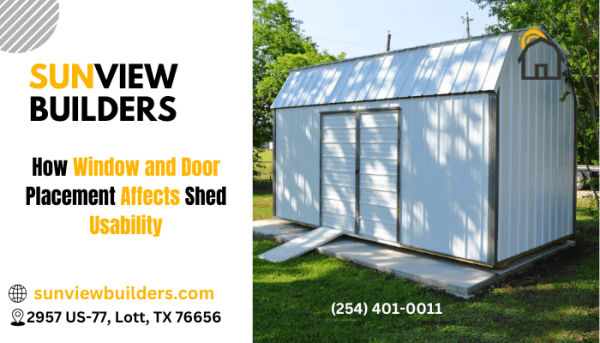
Most people design a shed the same way they pack a suitcase: put the big thing in first, then adjust everything else around it. That usually means they pick a size, choose a color, and then casually drop a door and a couple of windows wherever they “seem fine.”
But in real use, the shed doesn’t care what looks fine on paper. It responds to how you enter it, how light hits inside, where air moves, and how your body naturally flows through space. That is exactly where window and door placement becomes the difference between a shed you love using and one you avoid stepping into.
Let’s look at it in a more practical, real-life way.
Your Shed Has “Traffic Flow” (Even If You Don’t Plan It)
Every shed creates invisible movement paths. The moment you open the door, your body follows a natural route inside.
If the door is poorly placed, that path becomes awkward. You start dodging shelves, turning sideways with tools, or constantly rearranging things just to move comfortably.
What actually happens with different door positions
If the door is placed in the center:
You get equal movement on both sides, but you lose a clean wall for long storage setups.
If the door is pushed to one side:
You suddenly unlock a “long usable wall” which is perfect for workbenches, tool boards, or stacked storage.
If the door opens directly into a clutter zone:
You will subconsciously start avoiding that shed over time because it feels tight and stressful to use.
So the door is not just an entry point. It is the “movement director” of your shed.
Windows Don’t Just Bring Light, They Decide Where You Stand
Here is something most shed guides never mention: people naturally stand where the best light is.
If your window is on the wrong wall, your entire working position shifts awkwardly.
For example, if you are doing repairs or gardening work, you will always move toward brighter areas. That means your window placement is actually deciding where your workbench should be, whether you realize it or not.
Smart window behavior in real use
A side window near a workbench:
Makes the space feel like a mini workshop, not a storage box
A front-facing window near the door:
Makes the shed feel welcoming instead of closed-off
No windows at all:
The shed becomes “quick in and out only” space, not something you spend time in
So windows are not decoration. They are behavior controllers.
Door + Window Combo = The Shed Experience
The biggest mistake is designing doors and windows separately. In reality, they work like a system.
Think of it like this:
The door controls movement
The windows control attention and focus
When both are aligned properly, the shed starts feeling intentional instead of random.
Example of a good layout logic
Door on one side + window on opposite wall:
Creates natural airflow and prevents heat buildup
Door centered + two side windows:
Good for balanced lighting but less wall storage
Large double doors + minimal windows:
Best for equipment storage, not for working inside
The goal is not “more windows or bigger doors.” The goal is “right combination for your purpose.”
The Hidden Problem: Light Shadows You Don’t Notice at First
One of the most ignored usability issues is shadow zones.
If your window is behind you while working, your body blocks the light. That creates a constant low-level frustration: you keep shifting, but never get comfortable lighting.
This is why some sheds feel “off” even when they are well built.
A simple rule that works in real use:
Never place your main working zone where your body blocks the natural light source.
That one decision improves usability more than any expensive upgrade.
Airflow Is Not About Comfort, It’s About Usability
People think ventilation is only about heat. In reality, airflow affects how long you stay inside the shed.
A stagnant shed becomes a “grab and leave” space. A ventilated shed becomes a “work and stay” space.
Smart airflow logic
Door + opposite window:
Creates natural cross breeze
Two high windows:
Let hot air escape (very useful in warm climates)
Window near roof line:
Keeps walls free while still improving air circulation
If air does not move, the shed becomes mentally tiring to use, even if it is physically large.
Storage Placement Depends on Door First, Not Last
Here is a practical truth most people learn too late: your storage plan depends on your door position, not your shed size.
If you plan shelves before deciding door placement, you will almost always end up rearranging later.
Real-world logic
Door near corner:
Best for long uninterrupted shelving on one wall
Door in center:
Best for split storage zones (left tools, right supplies)
Wide double door:
Best for floor storage, bins, and equipment movement
The door decides your “storage language.”
Why Most Shed Layouts Feel “Off” Even When They Are Expensive
A shed can be high quality but still feel uncomfortable if placement is random.
Common symptoms of bad layout:
You bump into shelves when entering
Light never hits where you actually work
You avoid spending time inside
You keep reorganizing but nothing feels right
This is not a size problem. It is a placement problem.
Custom Design Is Not Luxury, It Is Efficiency
Custom shed design is not about adding fancy features. It is about aligning the structure with real human behavior.
At Sunview Builders, the idea is simple:
A shed should match how you actually move, work, and store things, not force you to adapt to it.
That means planning:
Where your body naturally enters
Where light supports your tasks
Where airflow keeps you comfortable
Where storage supports your daily use
When all of this is aligned, the shed stops feeling like a structure and starts feeling like a usable space.
Final Thought
Window and door placement is not a small design detail. It quietly controls how your shed behaves every single day.
If you get it right, even a small shed feels spacious, functional, and easy to use. If you get it wrong, even a large shed feels tight and frustrating.
Before finalizing any shed design, don’t just ask “how big should it be?” Consider the Shed usability beyond that as well.
Ask:
“How will I move inside it?”
“Where do I want the light to fall?”
“Where will I naturally spend most of my time?”
Those answers decide everything.