
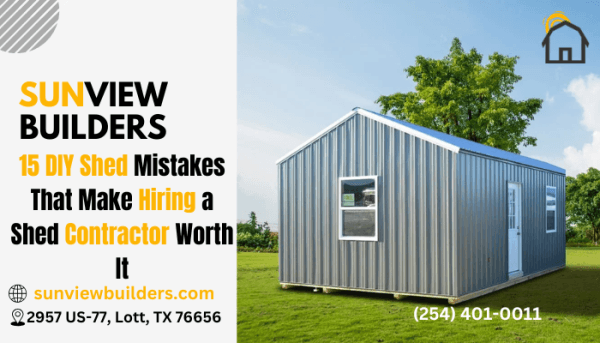
Building a shed in Texas often seems straightforward at first, but the reality of local conditions quickly tells a different story. Between intense summer heat, shifting clay soil, strong winds, and unpredictable storms, even a well-planned DIY project can start showing problems sooner than expected, such as uneven floors, leaking roofs, or structures that slowly lose alignment over time.
Industry experience shows that many DIY shed builds end up requiring corrections within the first year, most often due to foundation mistakes, material selection issues, and lack of weather planning. In Texas, these challenges are even more common because outdoor structures are constantly exposed to extreme environmental stress.
At Sunview Builders, we’ve seen how small oversights during planning and construction can turn into costly repairs later. The encouraging part is that most of these issues are entirely preventable with the right approach, or by working with experienced builders from the start.
Here are the 15 most common DIY shed mistakes Texas homeowners face, and how a professional contractor helps avoid them.
1. Poor Site Selection and Layout Planning
One of the earliest and most impactful mistakes happens before construction even begins.
Many DIY builders choose a location based on convenience instead of ground conditions. In Texas, this often leads to sheds placed in areas with poor drainage, excessive sun exposure, or uneven settling zones.
A professional contractor evaluates slope, drainage direction, sunlight exposure, and wind behavior before final placement, ensuring long-term stability from day one.
2. Ignoring Expansive Texas Soil Conditions
Much of Texas has clay-heavy soil that expands when wet and shrinks during dry periods. This constant movement creates instability for lightweight structures like sheds.
Without accounting for this behavior, DIY sheds often develop:
- Gradual leaning
- Cracked base structures
- Uneven settling
Contractors design foundations specifically to counteract soil movement.
3. Weak or Improper Foundation Installation
A shed foundation is not just a base; it is the structural backbone.
Common DIY mistakes include placing sheds directly on soil or using uneven blocks without compaction underneath. Over time, this leads to shifting floors and structural distortion.
Professionals choose foundation types based on load, soil, and intended use, such as gravel pads, skids, or reinforced concrete systems.
4. Lack of Drainage Planning Around the Structure
Water management is often overlooked but critically important in Texas weather conditions.
Without proper grading and runoff direction, water can collect under the shed, causing:
- Rotting wood
- Mold formation
- Base instability
A shed contractor ensures water flows away from the structure instead of toward it.
5. Selecting Low-Quality or Inappropriate Materials
Many DIY builders prioritize cost over durability, which often results in using materials not suited for Texas conditions.
Poor material choices lead to:
- Heat warping
- Moisture absorption
- Fast deterioration
Contractors use weather-rated, pressure-treated, and galvanized materials designed for long-term exposure.
6. Structural Misalignment During Construction
Even small measurement errors can create major long-term issues in a DIY shed.
If the frame is not perfectly square, it can result in:
- Sticking doors
- Uneven roofing
- Weak structural load distribution
Professionals rely on precise leveling tools and continuous measurement checks throughout construction.
7. Underestimating Wind and Storm Loads
Texas weather includes strong winds and occasional severe storms, which place significant pressure on outdoor structures.
DIY sheds often lack:
- Reinforced framing
- Proper roof bracing
- Wind-rated anchoring
Contractors design sheds to resist lateral pressure and uplift forces.
8. Using Incorrect Fasteners and Hardware
Not all screws and nails are designed for outdoor environments.
DIY builds often fail due to:
- Rusting fasteners
- Weak structural connectors
- Indoor-grade hardware usage
Professionals use galvanized, corrosion-resistant fasteners for durability.
9. Door Frame and Entry Misalignment
Doors are one of the first areas where DIY errors become visible.
This usually results from uneven foundations or incorrect framing, leading to:
- Doors not closing properly
- Gaps and air leaks
- Structural stress around entry points
Contractors reinforce and properly align all entry systems during installation.
10. Poor Ventilation and Heat Control
Texas heat can turn an unventilated DIY shed into an extreme-temperature environment.
Without airflow design, sheds experience:
- Heat buildup
- Moisture trapping
- Equipment damage
Professionals install vents or airflow systems to regulate internal conditions.
11. Building Without Future Storage Planning
DIY sheds are often designed only for immediate needs, not future usage.
Over time, homeowners realize they need more space for:
- Lawn equipment
- Tools and machinery
- Seasonal storage
Contractors design layouts with scalability in mind.
12. Inadequate Weather Sealing
Even small gaps in construction can lead to significant long-term damage.
Without proper sealing, sheds become vulnerable to:
- Water leaks
- Dust entry
- Pest infiltration
Professionals apply full perimeter sealing on joints, roofs, and siding.
13. Lack of Proper Anchoring Systems
Unanchored sheds are highly vulnerable in windy regions of Texas.
Without anchoring:
- Structures shift during storms
- Foundations loosen over time
- Overall safety decreases
Contractors install ground anchors or tie-down systems for stability.
14. Ignoring Insulation and Heat Protection Needs
Texas heat makes insulation an important factor even for storage sheds.
Without heat protection in a DIY shed.:
- Interior temperatures become extreme
- Materials degrade faster
- Usability decreases
Professionals may recommend insulation layers or reflective roofing systems.
15. Skipping Permit and Code Compliance Requirements
Many homeowners are unaware that DIY shed construction may require permits depending on size and location in Texas.
Skipping this step can lead to:
- Fines
- Forced modifications
- Legal issues
Contractors ensure compliance with local building regulations before construction begins.
Why DIY Shed Builds Often Fail in Texas Conditions
DIY sheds usually fail not because of one major mistake, but because of several small oversights combined. Texas climate conditions amplify these issues, making precision and planning essential.
Common long-term failures include:
- Foundation shifting
- Roof leakage
- Frame warping
- Moisture damage
What Most Texas Homeowners Don’t Realize Before Building a Shed
Before starting a DIY shed project, most homeowners focus on size, design, or cost, but overlook the conditions that actually determine whether the structure will last. In Texas, those conditions are far more demanding than many expect.
A professional shed contractor in Texas doesn’t just build walls and a roof; they design a structure around environmental stress factors that DIY builders usually miss completely.
Here are a few important realities most DIY builders don’t consider:
Texas heat can exceed safe material expansion limits, causing poorly built sheds to warp over time. Clay soil movement is not visible on the surface but can slowly shift an entire foundation within months. Storm winds don’t just damage roofs; they create uplift pressure that weak framing cannot resist.
This is why professional planning matters just as much as construction itself.
Why Sunview Builders Delivers Long-Term Shed Solutions
At Sunview Builders, every shed is designed specifically for Texas environmental conditions. Our process focuses on long-term durability rather than short-term convenience.
We ensure:
- Proper site and soil evaluation
- Storm-resistant structural design
- Durable, weather-rated materials
- Controlled drainage and ventilation planning
- Professional-grade installation
The Real Cost Difference Between DIY and Hiring a Shed Contractor
At first glance, DIY sheds seem cheaper, but hidden costs often change that calculation quickly.
Common unexpected DIY expenses include:
- Fixing foundation sinking or shifting
- Replacing warped or damaged wood
- Repairing leaks after storms
- Reinforcing weak framing after wind damage
- Rebuilding misaligned doors or roofing sections
In many cases, homeowners end up spending 30% to 60% more correcting mistakes than they would have spent hiring a professional shed contractor from the beginning.
The real value of professional construction is not just quality, it’s avoiding repeated repair costs.
Final Thoughts
A shed in Texas is more than just a storage space; it’s a long-term structure that has to stand up to extreme heat, shifting clay soil, high winds, and sudden storm conditions. Most DIY shed failures don’t happen because of one big mistake, but because of small technical details that are easy to overlook without professional experience in shed construction and shed installation.
Working with an experienced shed contractor in Texas, like Sunview Builders, ensures your project is built on a properly prepared foundation, uses weather-resistant materials, and follows proven construction methods designed for local conditions. The result is a shed that stays level, secure, and durable for years, without constant repairs or structural issues.
If you’re planning a shed, don’t leave it to guesswork. Get it done right the first time.
Call or WhatsApp Sunview Builders today at (254) 401-0011 to discuss your project, get expert guidance, or request a quote.
Or start designing your perfect shed with our FREE 3D Builder tool and see your structure before it’s built.
Build smarter. Build stronger. Build with Sunview Builders.